Keynote Speakers vs. Workshops: When Each Format Delivers Maximum Value
Two formats, two different jobs
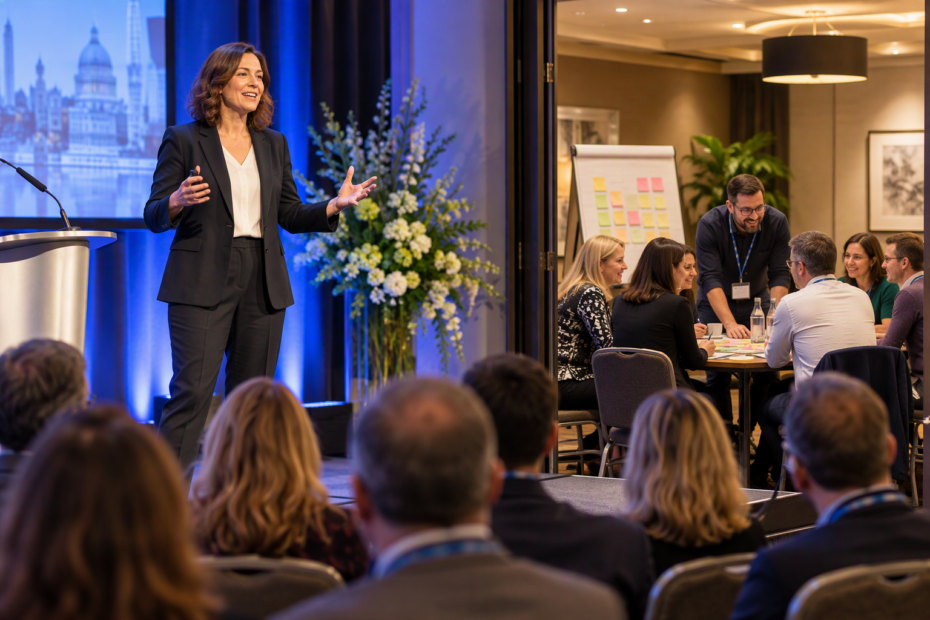
A keynote speech and a workshop may appear on the same conference agenda, but they do fundamentally different jobs. A keynote is designed to create a shared moment at scale. A workshop is designed to turn attention into participation, experimentation and practice. Choosing between them is therefore less about which format is ‘better’ and more about what you need the audience to be able to think, feel or do afterwards.
Event organisers sometimes blur the distinction. They ask a keynote speaker to deliver ninety minutes of detailed training to several hundred people, or expect a short workshop to produce the energy and collective identity of a main-stage address. Both can disappoint because the format is being asked to work against its strengths. Maximum value comes from matching the intervention to the outcome.
When a keynote earns its place
A strong keynote is particularly effective when a large group needs a common frame of reference. At the start of a conference it can establish a theme and give people language they will use throughout the day. Ahead of organisational change it can challenge established assumptions. At the end of an event it can pull diverse strands together and leave an idea vivid enough to travel back into the workplace.
Scale is an obvious advantage. One speaker can address hundreds or thousands of people at once without fragmenting the message. But scale alone is not the point. Good keynotes use story, structure, examples and performance to create concentration that is difficult to reproduce in an ordinary business meeting. The audience does not merely receive information; ideally, it sees familiar problems from a new angle.
Keynotes are especially useful for leadership events, association conferences, sales kick-offs and company gatherings where a sense of shared direction matters. They are less suitable when the primary goal is competence in a detailed process that requires supervised practice.
What a keynote should deliver
The best brief for a keynote is not ‘make people motivated’. Motivation without a target fades quickly. A better brief describes the shift you want: from seeing change as disruption to seeing it as a design challenge; from treating customer service as a department to recognising it as a company-wide behaviour; or from presenting data as reports to using it as a basis for decisions.
Give the speaker enough organisational context to make that shift relevant, while preserving the speaker’s distinctive point of view. Over-customising can be as damaging as under-customising. If every story and phrase is rewritten into company language, the keynote may sound like another internal presentation. The value of an external speaker often lies precisely in bringing a fresh perspective.
When a workshop delivers more value
Workshops become the stronger choice when success depends on application. Participants can discuss, practise, receive feedback, compare approaches and leave with decisions or outputs. A presentation-skills workshop, for example, can move from principles to short participant deliveries and targeted feedback. A strategy workshop can produce options, priorities and owners. A technical workshop can let people work through a process using realistic examples.
That active ingredient changes the economics of the session. Workshops usually serve fewer people at once and require more time, but they can create deeper transfer. The facilitator can detect misunderstanding, adapt the pace and make participants articulate how an idea applies in their own situation. This is valuable when the cost of incorrect implementation is higher than the cost of taking people away from their desks for longer.
Design the workshop around work, not slides
A workshop should not simply be a long keynote with occasional questions. If participants spend most of the time listening, the design is wasting the advantage of the format. Useful workshops cycle between concise input, activity, reflection and application. The proportions vary, but participants should repeatedly do something with the material.
Ask what tangible output should exist at the end. It might be a first draft, a decision map, a rehearsed opening, a prioritised action list or an agreed set of behaviours. The output creates focus and gives the organiser something more substantial than attendance to judge. It also helps participants reconnect with the session once normal work resumes.
Audience size and room design matter
Format decisions are affected by practical conditions. A theatre-style room holding 500 people naturally favours keynote delivery. A room with cabaret tables can support short collaborative exercises, but genuine coaching remains difficult at that scale. Conversely, putting twenty senior leaders into rows when the objective is to solve a shared problem may suppress the conversation you actually need.
For workshops, consider table layout, movement, acoustics, visibility, materials and the amount of facilitator attention required. If participants will practise a skill, calculate whether there is enough time for everybody to take part meaningfully. Ten people giving three-minute practice presentations plus feedback already consumes a substantial block of a session. A realistic design protects that time rather than squeezing the activity into the final minutes.
Use both when the outcome justifies it
The keynote-versus-workshop decision is not always an either/or choice. The formats can be deliberately connected. A keynote can create shared language and appetite, followed by smaller workshops in which teams apply the ideas. Alternatively, a workshop with leaders can precede a wider keynote, giving the speaker insight into the organisation and enabling senior people to reinforce the message afterwards.
This blended approach is particularly powerful when an organisation wants both reach and behaviour change. The danger is treating the workshop as an optional extra with no connection to the main-stage session. If the two formats are combined, design the handover: what idea moves from keynote to workshop, what activity develops it, and what happens once participants return to work?
Questions to ask before booking
Before choosing a format, define the audience, desired change and evidence of success. Do people mainly need a fresh perspective, or must they learn and practise a method? Is the priority to align a large population quickly, or to help a smaller group produce an output? How much time can genuinely be protected? What will happen after the event to reinforce the learning?
Then brief potential speakers or facilitators against those outcomes. Ask how they adapt to audience size, what level of interaction they use, what preparation they require and how they handle follow-through. Experienced professionals should be able to explain not only what they cover but why their chosen design supports the result you want.
Choose the format by the value it creates
Cost also needs to be viewed in context. A keynote may appear expensive as a single line item, yet its cost per participant can be low when a large audience receives a carefully prepared intervention. A workshop may cost more per participant but can justify that investment when the outcome requires practice, coaching or a concrete deliverable. Compare formats against the value of the desired change, not simply the speaker fee or the number of minutes on the agenda.
A keynote delivers maximum value when people need a memorable common idea, a shift in perspective and the energy of a shared experience. A workshop delivers maximum value when people need to examine, practise, decide and apply. Both formats can be exceptional, and both can be mediocre when the brief asks them to perform the wrong job.
Start with the outcome rather than the agenda slot. Once you can describe what should be different after the session, the choice becomes much clearer. The right speaker in the right format does not merely fill time at an event. The session becomes a purposeful part of what the organisation is trying to change.