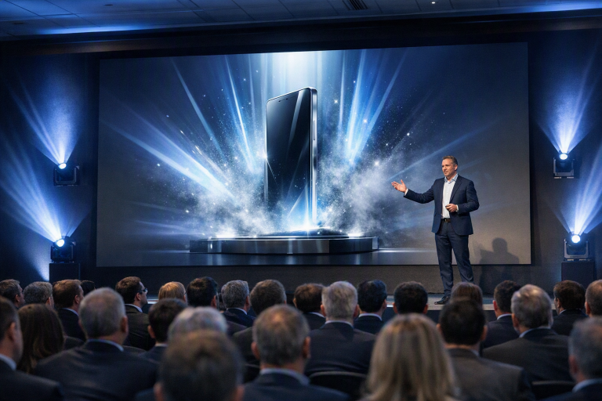
A Product Launch Needs More Than a Product
A successful product launch is not just a date in the diary. It is a carefully managed moment of attention, belief and momentum. Your product may be useful, innovative and commercially sound, but if the audience does not understand why it matters, the launch will fall flat. That is why keynote speakers are so valuable. They help transform a product announcement into a compelling business story.
Product launches often involve multiple audiences: customers, investors, partners, sales teams, journalists and internal stakeholders. Each group may care about different details, but all of them need clarity. A keynote speaker gives the launch a central message. Instead of leaving people to interpret product features for themselves, the speaker frames the product around a problem, a shift in the market and a clear reason to act.
Keynote Speakers Create the Big Picture
Most new products are launched with a list of benefits, specifications and demonstrations. Those are important, but they are not enough. People rarely remember a product launch because of a feature table. They remember the moment when the product suddenly made sense. A skilled keynote speaker connects the product to a bigger change: a customer frustration, a business challenge, a technology trend or a new opportunity.
This context matters because buyers are cautious. They are not simply asking, “What does it do?” They are asking, “Why now?”, “Why this solution?” and “Why should I trust it?” The keynote answers those questions before resistance hardens. By setting the scene properly, the speaker helps the audience see the product as timely, relevant and necessary rather than merely interesting.
They Turn Features into Stories
Features explain what a product can do. Stories explain why anyone should care. That distinction is critical. During a product launch, technical teams often know too much. They may speak in acronyms, workflows and specifications because they live inside the product every day. The audience does not. A keynote speaker acts as a translator, turning capability into meaning and complexity into a message people can repeat.
For example, instead of saying a platform offers “enhanced analytics integration”, a speaker might describe a manager finally spotting a costly problem before it damages a customer relationship. That simple shift changes the emotional weight of the product. It moves the conversation from functionality to outcome. In SEO terms, it also gives your launch richer language: product launch strategy, customer engagement, business impact and keynote speaker value.
A Strong Speaker Builds Credibility
Launching a new product asks people to believe in something that has not yet proved itself at scale. That makes credibility essential. A keynote speaker can lend authority by bringing outside perspective, sector knowledge and commercial experience. They can show that the problem is real, the opportunity is significant and the product is part of a wider movement, not a random invention looking for a market.
This is particularly powerful when the speaker is independent of the product team. Audiences expect founders and sales directors to be enthusiastic. They may be less guarded when an external expert explains the market need, shares relevant examples and challenges assumptions. The right keynote speaker becomes a bridge between brand enthusiasm and audience trust. That trust can shorten the distance between awareness and action.
They Energise the Room and the Campaign
A product launch event must feel like something is happening. Energy is not a cosmetic extra; it affects attention, recall and response. People are surrounded by digital noise, competing priorities and other announcements. A keynote speaker gives the launch pace, rhythm and emotional lift. They help the audience lean in before the demonstration, the sales conversation or the call to action.
That energy also extends beyond the room. A strong keynote provides quotable lines, short video clips, social media moments, blog angles and internal campaign messages. If your product launch marketing needs content for LinkedIn, newsletters, press outreach and follow-up emails, the keynote can supply a coherent narrative. Instead of pushing disconnected assets, the campaign repeats one memorable idea from several useful angles.
Keynote Speakers Align Internal Teams
Product launches do not fail only because customers misunderstand them. They also fail when internal teams tell different stories. Marketing may focus on brand positioning, sales may focus on price objections, product teams may focus on functionality and leadership may focus on growth. A keynote speaker can bring those strands together, giving everyone a shared language for the launch.
This is especially important for complex or high-value products. If salespeople cannot explain the product simply, buyers will not buy it confidently. If customer success teams do not understand the promise made at launch, delivery may disappoint. A keynote gives internal stakeholders the “why” behind the product. That makes subsequent conversations more consistent, persuasive and commercially useful.
They Make the Launch Memorable
A product launch competes with every other message your audience receives that week. Memory is therefore a commercial issue. People may forget the exact slide deck, but they can remember a story, a phrase or an image that captures the product’s value. A keynote speaker designs those moments deliberately. They give the audience something to talk about afterwards.
That follow-up conversation is where launches often succeed or fail. If people leave saying, “That was interesting,” nothing much happens. If they leave saying, “This solves a problem we have,” the launch has momentum. The keynote speaker helps create that second response. They make the product easier to remember, easier to recommend and easier to justify to other decision-makers.
Choosing the Right Keynote Speaker
The best keynote speaker for a product launch is not always the most famous person you can afford. Relevance beats celebrity. Look for someone who understands your audience, your market and the behaviour you want to influence. They should be able to simplify complexity without dumbing it down, challenge the audience without alienating them and support your product launch strategy without sounding like a sales pitch.
Brief the speaker properly. Share the product positioning, target audience, launch objectives, objections, customer stories and desired next steps. Ask them to connect their keynote to the wider event, not deliver a generic motivational speech. When the speaker’s message, your launch content and your follow-up campaign all point in the same direction, the product feels clearer, stronger and more urgent.
The Commercial Case for a Keynote Speaker
Hiring a keynote speaker should not be seen as decoration for a launch event. It is a strategic investment in attention, understanding and confidence. The launch may include a demonstration, customer testimonials, media activity and sales enablement, but the keynote gives those elements a unifying idea. It explains why the product matters before asking people to care about the details.
For businesses launching new products, that can be the difference between a brief spike of interest and a launch that builds lasting traction. A strong keynote speaker gives the audience context, confidence and a story they can carry into their own conversations. If you want your product launch to be remembered, repeated and acted upon, the right speaker is not optional. They are critical.